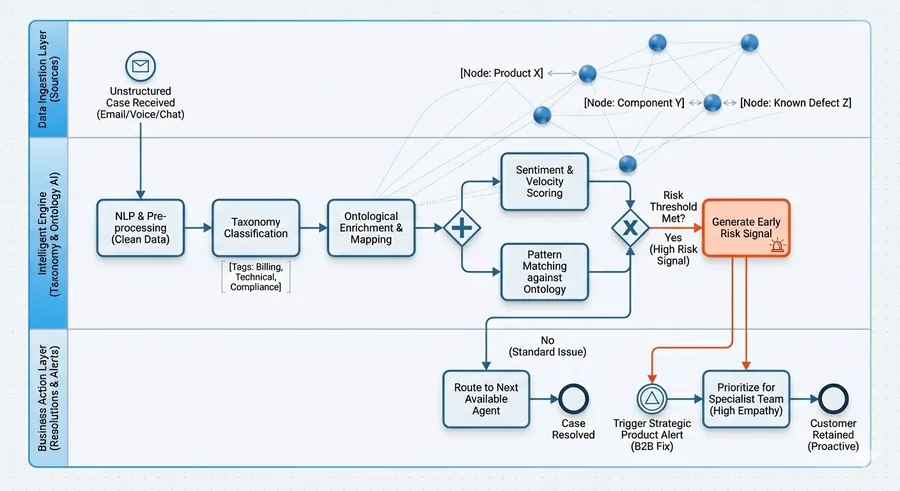
This diagram illustrates how ArthaShield fundamentally redesigns the complaint management process using Business Process Re-engineering (BPR) principles.
Instead of resolving complaints sequentially, ArthaShield introduces an intelligent decision layer that continuously learns from complaint patterns, product relationships, and historical risks.
01
Data Ingestion Layer
From noise to signal.
The process begins when an unstructured complaint is received via email, voice, or chat. Unlike legacy systems that rely on manual categorization, ArthaShield immediately moves the case into an automated intelligence pipeline.
BPR shift
Manual intake
→to
Automated, AI-ready ingestion
02
Intelligent Engine
Taxonomy + ontology at the core.
- •NLP & Pre-processing cleans and normalizes raw complaint data
- •Taxonomy Classification standardizes issues
- •Ontological Enrichment links complaints to products, components and known defects
BPR shift
Ticket classification
→to
Contextual risk understanding
03
Parallel Risk Evaluation
Speed and depth together.
Sentiment, escalation velocity, and pattern matching run in parallel and converge at a risk decision gateway to identify early warning signals.
BPR shift
Reactive review
→to
Continuous risk sensing
04
Proactive Business Actions
Not just resolution.
When high-risk signals are detected, ArthaShield triggers early alerts, routes customers to specialist teams, and enables preventive action.
BPR shift
Case closure
→to
Prevention & compliance